
Most WooCommerce stores that also run sales through Zoho CRM end up bridging the two by hand: someone opens each new order or quote request, copies the customer and line-item details into Zoho, and updates the deal stage manually. That works fine at low volume. It breaks down fast as order volume grows, more people touch the hand-off, or the store starts selling quote-based products alongside standard checkout — which is exactly the situation that led to the integration in this case study.
I built a real-time integration between WordPress/WooCommerce and Zoho CRM that pushes order and quote events straight into Zoho as they happen, instead of on a batch schedule or through a manual export. It reuses the same custom quote-plugin logic originally built for variable-product quoting, so quotes and standard orders flow into Zoho through one consistent pipeline rather than two different systems bolted together.
Why WooCommerce and Zoho CRM fall out of sync
The same handful of causes show up on almost every store running WooCommerce and Zoho side by side without a real integration:
- Manual re-entry — someone has to open every order or quote and retype it into Zoho, which doesn’t scale past a handful of orders a day.
- Delayed hand-off — sales doesn’t see a new lead or order until whoever’s responsible for data entry gets to it, which can be hours later.
- Data mismatch — a typo during manual entry, or a field that gets skipped, means WooCommerce and Zoho disagree about the same order.
- No single source of truth — with two systems updated independently, it’s never fully clear which one is current.
What makes this integration hard
Connecting WooCommerce to Zoho CRM sounds like a simple data hand-off. A few things make it more involved than it looks:
- Different data models — a WooCommerce order and a Zoho deal aren’t the same shape. Line items, statuses, and custom fields have to be mapped deliberately, not just copied field-for-field.
- Quotes aren’t orders — a store selling variable-product quotes alongside standard checkout needs both flows landing in Zoho correctly, without quotes getting treated as incomplete orders or dropped entirely.
- Duplicate prevention — an order that updates twice (a status change, a quote converting to a paid order) has to update the same Zoho record, not create a second one.
- Reliability — a webhook delivery can fail. Without retry handling, a single dropped request quietly becomes a lead that never reached the CRM.
Real-time sync vs. batch import
Most off-the-shelf WooCommerce-to-CRM connectors — including generic Zapier-style setups — poll on a schedule: check for new orders every few minutes, then push whatever’s new. That’s tolerable for reporting. It’s a real problem for sales, where the whole point of connecting the two systems is getting a lead in front of a rep before it goes cold.
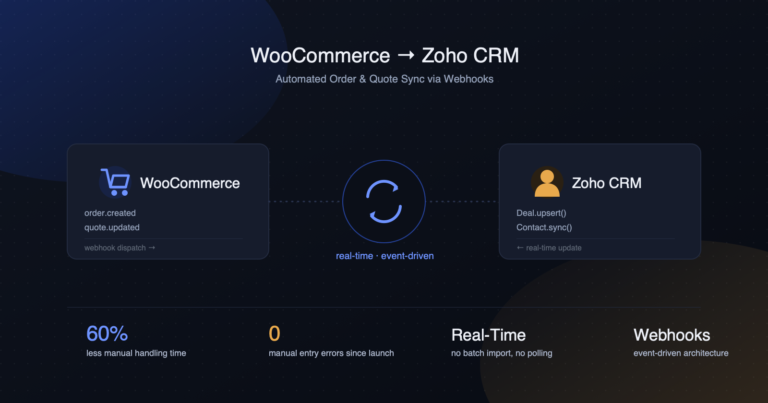
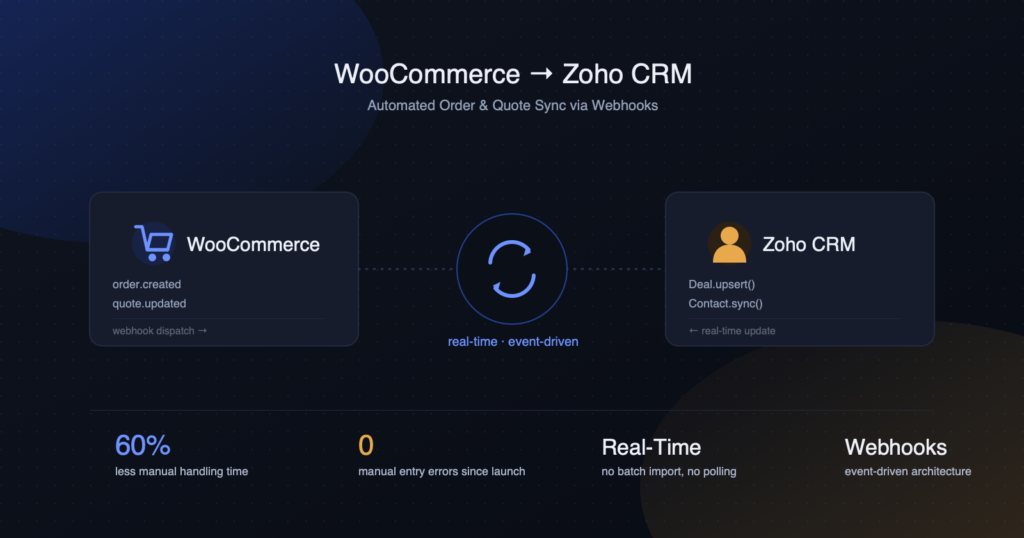
This integration is event-driven instead. WooCommerce fires a webhook the moment an order or quote event happens — created, updated, converted — and that webhook triggers an immediate push into Zoho through its API. There’s no polling interval to wait out and no batch job to run. The two systems are never more than a few seconds out of sync.
What I built
- Real-time order and quote sync from WooCommerce to Zoho CRM, triggered directly off WooCommerce’s own order/quote events.
- Shared logic with the quoting system — this reuses the same custom quote-plugin logic built for variable-product quoting, so quotes and standard orders sync through one pipeline instead of two separate integrations.
- No manual re-entry step between WooCommerce and the sales team’s CRM — sales works entirely out of Zoho for anything that started as a WooCommerce order or quote.
- Consistent data enforced between the two systems, so a status or detail change in WooCommerce reliably reflects in Zoho without someone double-checking it.
Results
- 60% reduction in time spent on manual lead/order handling.
- Zero manual entry errors since going live — nothing gets retyped, so nothing gets mistyped.
- Faster sales processing — leads and orders reach the sales team the moment they happen, with no manual hand-off step in between.
Common mistakes when connecting WooCommerce to a CRM
- Treating it as one-way sync only — pushing WooCommerce data into Zoho is half the picture; without a plan for what happens when a deal changes on the Zoho side, the two systems can still drift apart.
- Ignoring the quote stage — a store with quote-based products needs quotes represented in the CRM too, not just completed orders, or sales loses visibility into everything still in progress.
- No de-duplication strategy — without a stable identifier tying a WooCommerce order to its Zoho record, retries and status updates start creating duplicate deals.
- No retry handling on webhook failures — a webhook delivery can fail for reasons that have nothing to do with your code (a timeout, a brief Zoho outage). Without a retry mechanism, that failure is silent, and the record it should have created never actually exists in the CRM.
Is a custom integration worth it?
There are pre-built WooCommerce-to-Zoho plugins on the market, including Zoho’s own official connector. In practice, most of them are a mixed bag: many go long stretches without updates, which starts causing conflicts and breakage the moment WordPress, WooCommerce, or Zoho’s API changes underneath them. Even Zoho’s own plugin is limited in what it covers — it wasn’t built around quote-based products or custom order states, so it falls short exactly where a store with real complexity needs it to hold up.
Generic connectors are a reasonable starting point if the volume is low and the workflow is simple: one product type, standard checkout only, no quoting step. Once a store has custom order logic — quote-based products, multiple order states that matter to sales, or CRM fields that need specific mapping rather than a generic field match — a purpose-built WordPress API integration ends up more reliable than trying to configure a generic tool around logic it wasn’t built for, or to keep patching a plugin that’s fallen behind. It’s also the only way to get genuinely real-time sync rather than a polling interval measured in minutes.
Building it custom also means it isn’t tied to someone else’s update schedule. It runs cleanly on whatever WooCommerce and WordPress versions are in use right now, and because I own the code, I can go back in and extend or adjust it any time the sales process changes — add a new event type, change a field mapping, support a second CRM stage — without waiting on a plugin vendor to ship it or working around whatever the plugin happens to let you configure.
If your team is still copying WooCommerce orders or quotes into Zoho by hand, or your current connector is close but doesn’t handle quotes, custom fields, or real-time delivery the way your sales process needs, I’ve built exactly this kind of integration before — see the full WooCommerce to Zoho CRM sync case study for the complete breakdown. I take on a limited number of freelance engagements at a time — reach out and I’ll get back to you within 24–48 hours.